CONSTRUCTION WATERPROOFING CHEMICALS · 27 Jun 2026
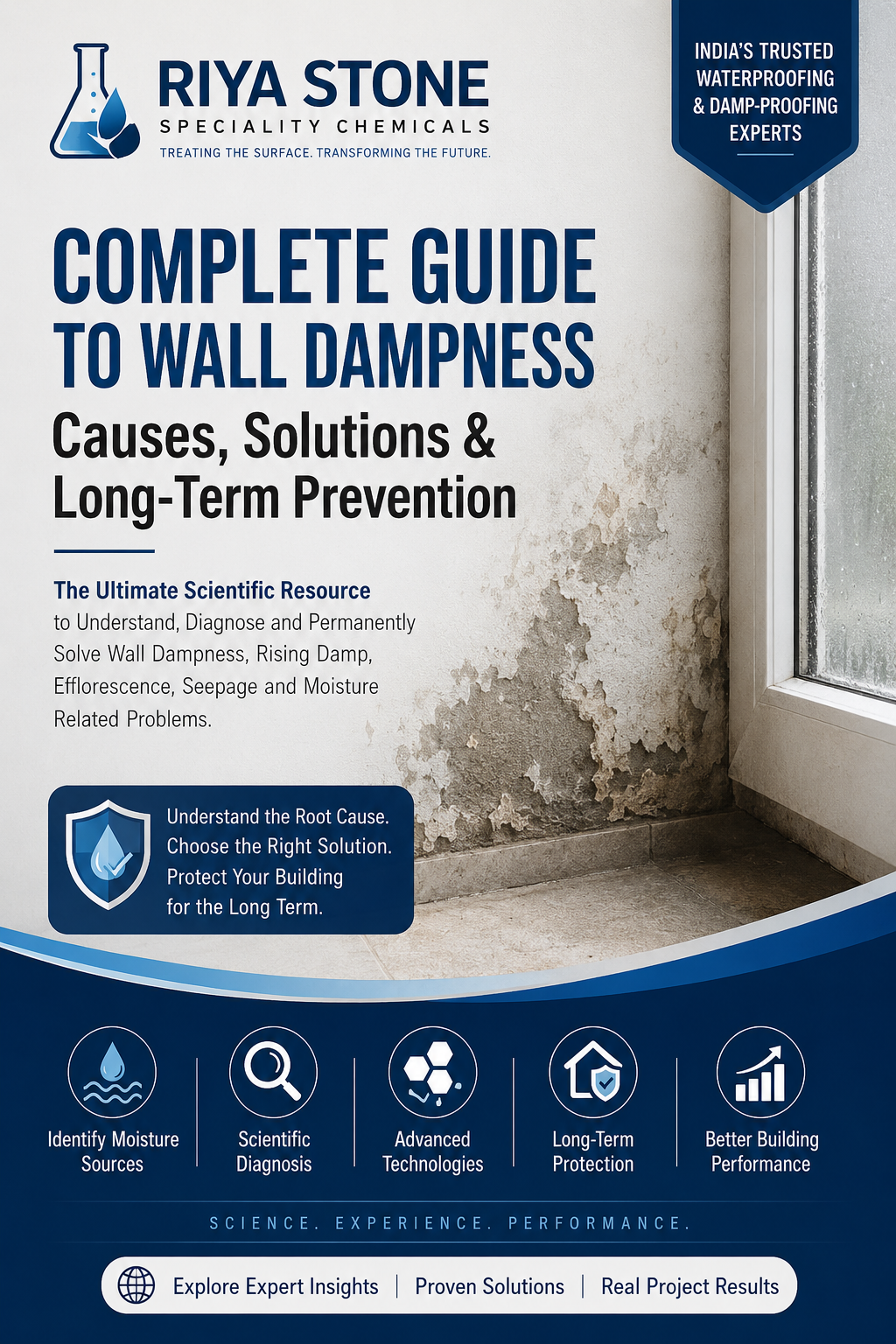
Wall dampness is one of the most common and costly building problems affecting homes, apartments, commercial buildings and industrial structures across India. What often begins as a small damp patch on a wall can gradually develop into peeling paint, damaged putty, white salt deposits (efflorescence), fungus, algae growth, weakened plaster and, in severe cases, deterioration of the building itself.
Many homeowners believe that repainting the wall or applying another waterproof coating will permanently solve the problem. Unfortunately, this is rarely the case. In most situations, the visible dampness is only a symptom. The real problem lies inside the wall, where moisture continues to move through the building materials, carrying dissolved salts and causing continuous damage from within.
This is why the same wall often becomes damp again even after repeated repairs.
The key to solving wall dampness is not simply hiding the visible stains or sealing the surface. It is understanding why the wall became damp in the first place and addressing the root cause.
In this complete guide, you will learn:
Whether you are a homeowner, architect, contractor, builder or facility manager, this guide will help you understand wall dampness from an engineering perspective while explaining every concept in simple, practical language.
Wall dampness is the unwanted presence or continuous movement of moisture within a wall, causing the wall to become wet, stained and damaged over time.
Unlike rainwater that falls on the surface and dries naturally, dampness is a continuous process. Moisture keeps entering or moving through the wall from one or more sources, preventing the wall from drying completely.
This moisture may originate from several different sources, including:
Once moisture enters the wall, it begins travelling through millions of microscopic interconnected pores naturally present in concrete, cement plaster, brick masonry and mortar.
As the moisture moves through these tiny capillary pathways, it dissolves naturally occurring salts present within the building materials and carries them towards the wall surface.
When the moisture finally evaporates, the salts remain behind, forming the familiar white powdery deposits known as efflorescence.
At the same time, continuous moisture movement gradually weakens the plaster, damages paint and putty, encourages fungus and algae growth, and creates the damp patches commonly seen on interior walls.
This is why wall dampness is not just a cosmetic issue. It is an indication that moisture is actively moving inside the wall.
One of the biggest misconceptions is that dampness itself is the problem.
In reality, wall dampness is only the visible symptom. The real problem is the continuous movement of moisture and dissolved salts inside the wall.
Unless this internal moisture activity is properly controlled, repainting the wall, replacing the putty or simply applying another waterproof coating often provides only temporary relief. The dampness usually returns because the root cause continues to exist beneath the surface.
Understanding this concept is the first and most important step towards selecting the correct damp-proofing and waterproofing solution.
One of the biggest misconceptions about wall dampness is that it starts when a damp patch appears on the wall.
In reality, by the time you notice a damp patch, the problem has usually been developing inside the wall for weeks, months or even years.
Wall dampness is a gradual process. It begins when moisture enters the building through one or more sources and starts travelling through the microscopic capillary pores naturally present in concrete, cement plaster, brick masonry and mortar.
Because these construction materials are porous, they can absorb and transport moisture internally. This process is known as capillary moisture movement.
The journey of wall dampness generally follows this sequence:
Moisture can enter a building from several different sources, including:
Although the source of moisture may vary, the result is the same—moisture begins entering the wall.
Once moisture enters the wall, it does not remain at one location.
Instead, it begins moving through thousands of microscopic capillary pores inside the construction material.
Unlike visible cracks, these capillary pores are naturally present in almost every cementitious material.
This is why moisture can often travel considerable distances inside a wall before becoming visible on the surface.
Construction materials naturally contain various mineral salts.
As moisture moves through the wall, it dissolves these salts and carries them towards the surface.
This continuous movement of dissolved salts is known as salt migration.
Although invisible initially, salt migration plays a major role in long-term wall deterioration.
Eventually, the moisture reaches the wall surface.
Here, the water begins to evaporate into the surrounding air.
However, the dissolved salts cannot evaporate.
Instead, they remain on or just beneath the surface.
This is why white powdery deposits gradually begin appearing on damp walls.
These deposits are known as efflorescence.
As moisture and salts continue to move through the wall, the first visible signs of damage begin to appear.
These commonly include:
Unfortunately, these are only the visible symptoms.
The actual moisture activity is still continuing inside the wall.
Many people repair the visible damage by repainting the wall or applying another waterproof coating.
While this may temporarily improve the appearance, the underlying moisture movement often continues inside the wall.
As long as moisture keeps travelling through the structure, the same problems usually return.
This is why successful damp-proofing begins with identifying and controlling the source and movement of moisture rather than simply covering the visible symptoms.
Contrary to popular belief, water visible on the wall is not the real problem.
The real problem is the continuous movement of moisture inside the wall.
Unless this internal moisture movement is properly controlled, dampness-related problems are likely to reappear, regardless of how many times the surface is repaired.
Wall dampness rarely appears overnight.
In most cases, it develops gradually, giving several warning signs before serious structural or aesthetic damage occurs.
Recognizing these early symptoms allows the problem to be identified and corrected before it becomes more expensive to repair.
Below are some of the most common signs that indicate moisture is actively affecting a wall.
Dark or wet-looking patches appearing on walls are usually the first visible indication of moisture movement inside the building.
These patches often become more noticeable during the rainy season or after prolonged exposure to moisture.
One of the most common signs of dampness is paint that begins to bubble, blister or peel away from the wall.
This occurs because continuous moisture weakens the bond between the wall and the paint layer.
Wall putty absorbs moisture over time.
As moisture activity continues behind the surface, the putty gradually softens, loses strength and eventually begins to detach from the wall.
White powdery deposits appearing on the wall are known as efflorescence.
These deposits are formed when moisture carries dissolved salts through the wall and leaves them behind after evaporation.
Efflorescence is one of the strongest indicators of continuous moisture movement inside the structure.
Persistently damp surfaces create favourable conditions for fungus, mold and algae.
Besides damaging the appearance of the wall, microbial growth may also affect indoor hygiene and air quality.
Moisture gradually reduces the strength of plaster.
Walls may begin sounding hollow, become soft to touch or develop localised deterioration over time.
A persistent damp or musty smell inside a room often indicates hidden moisture even before visible damage appears.
This is particularly common in poorly ventilated spaces.
Water entering through terraces or roofs may eventually appear as damp patches or stains on ceilings.
Ignoring these early signs often leads to more extensive repairs later.
If freshly painted walls repeatedly develop peeling, bubbling or discoloration within a short period, the underlying problem is often moisture rather than poor-quality paint.
One of the biggest warning signs is the need for repeated repairs.
If the same wall requires repainting, replastering or waterproofing every few years, the root cause of dampness has likely never been addressed.
Many people initially treat dampness as a cosmetic issue.
However, prolonged moisture activity can gradually affect the durability, appearance and performance of the entire wall system.
The longer the problem remains untreated, the more extensive and expensive the repairs usually become.
For this reason, early diagnosis and identifying the actual source of moisture are far more important than repeatedly repairing the visible damage.
Not all dampness problems are the same.
Many homeowners assume that every damp wall can be repaired using the same waterproofing product or method. In reality, wall dampness can occur due to several different reasons, and each type requires a different treatment approach.
Identifying the correct type of dampness is one of the most important steps before selecting any waterproofing or damp-proofing solution.
Below are the most common types of wall dampness found in residential, commercial and industrial buildings.
Rising damp occurs when ground moisture travels upward through the foundation and lower sections of the wall.
Since concrete, brick masonry and cement plaster contain microscopic capillary pores, moisture can slowly move upward against gravity through these interconnected pathways.
Common Signs:
Rising damp is one of the most common problems in ground-floor buildings and older structures.
Penetrating damp occurs when rainwater enters the building through external walls.
Water usually enters through:
Common Signs:
Terraces are constantly exposed to sunlight, rain and temperature changes.
Over time, cracks, weak joints and deteriorated waterproofing systems allow water to penetrate into the roof structure.
Common Signs:
Hidden water supply pipes and drainage pipes may develop leaks over time.
Unlike rainwater leakage, plumbing leakage can occur throughout the year.
Common Signs:
Newly constructed buildings often contain a large amount of moisture trapped inside concrete, plaster and mortar.
If finishing work is carried out before sufficient drying, this moisture gradually moves towards the surface.
Common Signs:
Condensation occurs when warm humid air comes into contact with a cold wall surface.
It is commonly found in bathrooms, kitchens and poorly ventilated rooms.
Common Signs:
Many dampness problems look similar from the outside.
However, the actual source of moisture may be completely different.
Applying the wrong treatment without identifying the root cause often results in repeated failures and unnecessary repair costs.
A proper inspection should always determine:
Only after understanding these factors can the correct treatment system be selected.
One of the most frustrating situations for homeowners is when freshly painted walls begin peeling again within a few months.
Many people blame the paint brand, the painter or the quality of the putty.
However, in a large number of cases, the real reason lies much deeper inside the wall.
Paint and putty are finishing materials.
They are designed to protect and beautify the surface—not to stop continuous moisture movement inside the wall.
When moisture remains active behind the surface, even the highest-quality paint systems eventually begin to fail.
Imagine applying expensive paint over a continuously wet wall.
Although the wall may initially look perfect, moisture continues moving behind the paint layer.
Over time, this moisture creates pressure between the wall and the coating.
Eventually, the paint loses adhesion and begins to separate from the surface.
The same process affects wall putty.
Continuous moisture weakens the putty, causing it to soften, crack and detach from the wall.
The failure generally follows this sequence:
Moisture enters the wall.
↓
Moisture begins travelling inside the wall.
↓
Salts move with the moisture.
↓
Moisture reaches the paint layer.
↓
Paint loses adhesion.
↓
Blisters appear.
↓
Paint begins peeling.
↓
The same problem returns again.
As moisture moves through the wall, it carries dissolved mineral salts towards the surface.
When the water evaporates, these salts remain trapped beneath or on the paint layer.
Over time, salt crystals expand and create pressure behind the coating.
This pressure gradually pushes the paint away from the wall.
This is one of the primary reasons why paint and putty repeatedly fail on damp walls.
Many homeowners repaint damp walls every year.
Initially, the wall appears clean and attractive.
However, because the internal moisture problem remains unresolved, the same symptoms gradually return.
Repainting without controlling the underlying moisture is similar to treating the symptom while ignoring the disease.
Instead of asking:
"Which paint should I use?"
The better question is:
"Why is moisture reaching my wall surface?"
Once the source and movement of moisture are identified and controlled, paint, putty and finishing systems perform significantly better and last much longer.
For this reason, professional damp-proofing should always begin with controlling the conditions responsible for moisture movement rather than simply applying another decorative coating.
One of the most common questions asked by homeowners is:
"Why are white powdery deposits appearing on my walls?"
Many people believe these white deposits are cement, lime or plaster coming out of the wall.
In reality, they are known as Efflorescence—one of the strongest indicators that moisture is actively moving inside the wall.
Efflorescence is not the root problem. It is the visible result of a much larger process taking place within the building structure.
Understanding this process is essential for selecting the right damp-proofing solution.
Efflorescence is the white crystalline or powdery deposit that appears on walls, ceilings, brickwork, plaster, concrete and other cementitious surfaces.
It forms when water dissolves naturally occurring salts inside building materials and carries them towards the surface.
As the water evaporates, the dissolved salts remain behind, creating the familiar white deposits seen on damp walls.
The process occurs in five simple stages.
Water enters through one or more sources such as:
Concrete, cement, plaster, mortar and bricks naturally contain soluble mineral salts.
As moisture moves through these materials, it dissolves the salts present inside them.
The dissolved salts now travel together with the moving moisture.
This continuous movement of dissolved salts inside the wall is known as Salt Migration.
Although invisible at this stage, it is continuously occurring wherever moisture movement exists.
Eventually, the moisture reaches the wall surface and begins to evaporate.
Since only water evaporates, the dissolved salts remain behind.
As this process continues repeatedly, white crystalline deposits gradually accumulate on the surface.
These deposits are called Efflorescence.
They are a clear indication that moisture and salts are continuously moving inside the wall.
Many people simply clean the white deposits and repaint the wall.
Unfortunately, this does not solve the problem.
As long as moisture continues moving inside the wall, salts will continue migrating to the surface.
Repeated cleaning only removes the visible deposits—it does not stop the process happening inside the wall.
Over time, continuous salt migration may result in:
This is one of the most common frustrations faced by homeowners.
The white deposits disappear after cleaning but return again after a few weeks or months.
This happens because the source of moisture has not been addressed.
As long as moisture keeps travelling through the wall, it will continue carrying salts towards the surface.
Until moisture movement is controlled, efflorescence is likely to reappear.
Efflorescence should never be treated as an isolated surface problem.
The correct approach is to identify:
Only after addressing these conditions can recurring efflorescence be effectively controlled.
Simply removing the white deposits without solving the underlying moisture problem usually provides only temporary improvement.
One of the biggest questions homeowners ask is:
"If I already spent money on waterproofing, why has the leakage come back?"
Unfortunately, this is one of the most common situations in the construction industry.
Many buildings undergo waterproofing multiple times, yet dampness, seepage and efflorescence continue to return.
The reason is simple.
In many cases, the treatment addresses the visible symptoms rather than the actual cause of the problem.
Every dampness problem has a cause.
Before selecting any waterproofing system, it is important to determine:
If these questions remain unanswered, even a high-quality waterproofing product may not deliver long-term performance.
Many conventional waterproofing methods focus on creating a protective layer over the surface.
While surface protection is important, it may not fully address moisture that is already present or actively moving inside the wall.
If moisture continues travelling beneath the waterproof layer, pressure may gradually build behind the coating.
Over time, this can contribute to:
This is one of the reasons why some waterproofing treatments appear successful initially but fail after repeated exposure to moisture.
No single waterproofing method is suitable for every situation.
For example:
Applying the same treatment to every problem often leads to disappointing results.
Correct diagnosis should always come before product selection.
Long-term waterproofing begins by understanding why the problem exists.
This includes identifying:
Once these factors are properly understood, an appropriate treatment system can be selected.
Successful waterproofing is not simply about applying another coating.
It is about understanding how moisture behaves inside a building and selecting technologies that address the conditions responsible for recurring dampness.
When moisture movement, salt migration and weak structural areas are properly managed, waterproofing systems generally perform more effectively and require less frequent maintenance.
By now, we know that damp patches, peeling paint and white salt deposits are only visible symptoms.
The real problem usually begins much deeper inside the wall, where moisture continuously moves through the building materials.
This is one of the most misunderstood aspects of waterproofing.
Many people focus on what they can see on the wall surface, while the actual damage is being caused by what they cannot see inside the wall.
Understanding moisture movement is therefore essential for selecting the correct long-term solution.
Water naturally moves from areas of higher moisture concentration towards areas of lower moisture concentration.
If a wall contains interconnected pores, cracks or weak joints, moisture will continue travelling through these pathways whenever favourable conditions exist.
This movement may occur due to:
Even if the wall appears dry externally, moisture may still be actively moving within the building structure.
Many people believe dampness is a one-time event.
In reality, dampness is often a continuous cycle.
Moisture enters the wall.
↓
Moisture moves through microscopic pores.
↓
Salts travel with the moisture.
↓
Moisture reaches the surface.
↓
Water evaporates.
↓
Salt remains behind.
↓
More moisture enters again.
↓
The entire cycle repeats.
Unless this cycle is interrupted, dampness-related problems continue returning.
Traditional thinking focuses on hiding the visible dampness.
A more scientific approach focuses on controlling the conditions that allow moisture to continuously travel inside the wall.
When moisture movement is controlled, several problems can also be significantly reduced, including:
Instead of repeatedly repairing the symptoms, the objective should be to interrupt the moisture cycle itself.
Every wall has a different moisture history.
Some walls suffer from rising damp.
Others are affected by terrace leakage.
Some have plumbing leakage.
Others still contain construction trapped moisture.
If the source of moisture is not correctly identified, selecting the right treatment becomes extremely difficult.
Professional waterproofing should therefore begin with diagnosis—not product selection.
A doctor first diagnoses the disease before prescribing medicine.
Similarly, waterproofing should begin by understanding:
Only after answering these questions should an appropriate treatment system be selected.
This approach provides a much greater chance of achieving long-term performance than repeatedly repairing visible damage alone.
For decades, most waterproofing solutions have focused on creating a protective layer on the surface.
While surface protection plays an important role in many applications, recurring dampness often indicates that moisture activity is occurring within the wall itself.
This raises an important question:
What if the problem could be addressed before moisture reaches the wall surface?
This philosophy led to the development of ESPLENDIDO SILANSTOP™.
Instead of asking,
"How do we hide dampness?"
A better question is,
"Why is moisture continuously reaching the wall surface?"
By changing this perspective, the focus shifts from treating symptoms to understanding the conditions responsible for recurring dampness.
ESPLENDIDO SILANSTOP™ has been developed with a different objective.
Rather than functioning simply as another surface-applied waterproof coating, it is designed as a moisture management technology that works within the building substrate.
Its purpose is to help address some of the hidden conditions associated with recurring dampness, including:
By addressing these conditions, the technology aims to reduce the processes responsible for many recurring moisture-related problems.
When moisture continuously travels inside a wall, it may contribute to:
Reducing unnecessary moisture movement inside the wall helps create a more stable substrate for subsequent finishing systems.
One of the most common mistakes is applying decorative finishes over walls that still contain active moisture.
No matter how premium the paint or putty may be, continuous moisture movement beneath the surface can eventually affect its performance.
For this reason, controlling moisture before applying decorative finishes is often a more effective long-term strategy.
Effective damp-proofing is no longer only about creating barriers.
It is about understanding how moisture behaves, how salts move through building materials and how these processes contribute to recurring failures.
Modern moisture management technologies are increasingly focused on addressing these underlying conditions rather than simply treating their visible effects.
This represents a shift from reactive repairs towards a more scientific, preventive approach to building protection.
After understanding how moisture moves through a wall and why conventional waterproofing treatments often fail, the next question is:
How can this continuous moisture activity be controlled?
This is where ESPLENDIDO SILANSTOP™ takes a different approach.
Instead of simply covering the wall with another waterproof coating, SilanStop™ is designed to work inside the building substrate, where many moisture-related problems begin.
Its objective is not to hide dampness but to help manage the internal conditions responsible for recurring moisture damage.
Traditional waterproofing systems generally focus on stopping water at the surface.
ESPLENDIDO SILANSTOP™ is designed to address what happens inside the wall.
Once applied, the technology penetrates into the porous construction material and helps create an internal moisture management zone.
Rather than allowing continuous moisture movement through the wall, the technology is designed to reduce moisture migration within the substrate itself.
This helps minimise the conditions responsible for many recurring dampness problems.
Most visible dampness appears only after moisture has already travelled through the wall.
By the time paint begins peeling or white salt deposits become visible, moisture has usually been active inside the structure for a considerable period.
ESPLENDIDO SILANSTOP™ is designed to help interrupt this process before moisture reaches the wall surface.
By helping manage internal moisture movement, it reduces the conditions that contribute to:
Moisture alone is not responsible for most wall damage.
As moisture travels through cementitious materials, it carries dissolved mineral salts with it.
These salts eventually reach the surface and form efflorescence while also contributing to paint failure and plaster deterioration.
ESPLENDIDO SILANSTOP™ is designed to help manage the movement of both moisture and dissolved salts within the wall, making it fundamentally different from systems that only protect the outer surface.
Every paint system, putty layer and decorative finish depends upon the condition of the substrate beneath it.
If moisture remains active inside the wall, even premium finishing materials may experience reduced service life.
By helping reduce internal moisture activity, the substrate becomes more stable for subsequent finishing systems.
This improves the overall performance of the complete wall protection system.
ESPLENDIDO SILANSTOP™ represents a different philosophy of damp-proofing.
Instead of concentrating only on stopping visible water, it focuses on understanding and managing the internal moisture conditions responsible for recurring dampness.
This scientific approach makes it suitable for a wide range of moisture-related building problems where long-term moisture management is required.
One of the biggest advantages of ESPLENDIDO SILANSTOP™ is its versatility.
Because moisture movement can occur in many different parts of a building, the technology can be incorporated into a wide range of damp-proofing and waterproofing applications.
The treatment is suitable for both new construction and existing buildings where long-term moisture management is required.
Walls affected by rising ground moisture often develop damp patches, white salt deposits and peeling paint.
ESPLENDIDO SILANSTOP™ is designed to help manage the internal moisture conditions associated with these problems before they reach the wall surface.
External walls remain continuously exposed to rain, humidity and changing weather conditions.
Over time, moisture may enter through porous plaster, weak joints and hairline cracks.
Treating the substrate helps improve long-term moisture management before visible damage develops.
Moisture entering through terraces often leads to ceiling seepage and internal wall dampness.
As part of a systematic waterproofing process, ESPLENDIDO SILANSTOP™ can be incorporated before subsequent waterproofing treatments to help prepare and stabilise the substrate.
Bathrooms, utility rooms and other wet areas are continuously exposed to water.
Moisture can gradually penetrate surrounding walls and floors if not properly managed.
Using an appropriate moisture management system during waterproofing can help improve long-term performance.
Basements remain under continuous moisture pressure from surrounding soil.
Managing moisture movement within foundation walls is an important part of long-term building protection.
Both underground and overhead water tanks require reliable waterproofing systems capable of managing continuous exposure to moisture.
Proper substrate preparation plays an important role in achieving durable waterproofing performance.
Older buildings often contain porous masonry that has been exposed to moisture for decades.
Conventional surface coatings may not always be suitable for heritage structures.
Technologies designed to work within the substrate can provide an alternative approach while preserving the original construction.
Freshly constructed walls frequently contain construction trapped moisture.
Treating the substrate before applying putty and paint helps create better conditions for long-lasting decorative finishes.
ESPLENDIDO SILANSTOP™ can be considered for:
Every building experiences moisture differently.
Rather than offering a single solution for every situation, ESPLENDIDO SILANSTOP™ is designed to become part of a scientific damp-proofing approach that begins with proper diagnosis, identifies the source of moisture and helps manage the internal conditions responsible for recurring dampness.
Successfully treating wall dampness is not about applying a single product. It requires a systematic approach that begins with identifying the source of moisture and ends with creating a stable substrate for long-term protection.
At Riya Stone Speciality Chemicals, we follow a scientific treatment process designed to address the root cause of recurring dampness rather than simply covering the visible symptoms.
Every damp wall tells a different story.
Before selecting any treatment, it is important to identify where the moisture is coming from.
The source may be:
Without proper diagnosis, even the best waterproofing products may not deliver long-term performance.
The affected wall should be properly prepared before any treatment begins.
This includes removing:
A clean and sound substrate allows the treatment system to perform more effectively.
Once the surface has been prepared, ESPLENDIDO SILANSTOP™ is uniformly applied to the substrate.
Unlike conventional surface coatings, the technology is designed to penetrate into the porous construction material and help manage internal moisture movement and salt migration.
This step forms the foundation of the complete damp-proofing system.
Its objective is to help reduce the internal conditions responsible for recurring dampness before decorative finishes are applied.
After treatment, the surface should be inspected to verify that moisture-prone areas have been properly identified.
Where necessary, moisture behaviour can be assessed through appropriate inspection methods before proceeding to the next stage.
This step helps ensure that hidden problem areas are not overlooked.
If cracks, weak joints or damaged areas are identified during inspection, they should be repaired using an appropriate crack-bridging repair system before finishing work begins.
Repairing only the visible surface without addressing structural weak points may result in recurring moisture problems.
Depending on the application, the treated wall may now receive an appropriate reinforcing system before decorative finishes such as putty, primer and paint are applied.
Since the substrate has already been prepared and moisture conditions have been addressed, finishing materials are able to perform under significantly better conditions.
Each stage of the treatment process performs a specific function.
Skipping any step may reduce the overall effectiveness of the complete system.
By following a structured sequence, the wall is progressively prepared, treated, repaired and finished to achieve long-term performance rather than temporary cosmetic improvement.
Successful damp-proofing is therefore not defined by a single product—it is the result of a correctly designed treatment system.
For many years, waterproofing has largely been associated with applying thicker coatings, stronger membranes or additional protective layers.
While these systems play an important role in many applications, recurring dampness often indicates that the underlying moisture conditions have not been fully addressed.
This is where the concept of Moisture Control becomes increasingly important.
By the time a damp patch appears on a wall, moisture has usually been travelling inside the structure for a considerable period.
The visible damage is only the final stage of a much longer process.
If only the visible surface is repaired, the internal moisture activity may continue.
Eventually, the same problems can reappear.
Many common building problems are directly or indirectly associated with continuous moisture movement.
These include:
Although these problems appear different, they often share one common factor—active moisture movement within the building materials.
Instead of asking:
"Which waterproof coating should I apply?"
A more important question is:
"Why is moisture continuously moving inside my wall?"
When moisture movement is properly managed, the conditions responsible for many recurring dampness problems can also be significantly reduced.
This creates a more stable environment for waterproofing systems, decorative coatings and finishing materials.
Surface waterproofing focuses primarily on protecting the exposed surface from water.
Moisture management goes a step further by considering what is happening inside the building substrate.
It recognises that moisture movement, salt migration and substrate condition all influence the long-term performance of the entire wall system.
Rather than viewing waterproofing as a single layer, moisture management considers the complete behaviour of the wall.
A durable wall is not defined only by how well it resists rain from the outside.
Its long-term performance also depends on how effectively internal moisture is managed.
This is why modern damp-proofing increasingly focuses on controlling the conditions responsible for moisture movement before visible damage occurs.
The future of waterproofing is not simply applying more material.
It is understanding building science.
By controlling moisture movement, managing salt migration, repairing weak areas and preparing a stable substrate, buildings can be protected more effectively for the long term.
This represents a shift from temporary repairs to scientific moisture management—an approach that focuses on preventing recurring problems rather than repeatedly repairing their visible effects.
Below are answers to some of the most common questions asked by homeowners, builders, architects and contractors about wall dampness, waterproofing and moisture-related problems.
Wall dampness is the continuous presence or movement of moisture inside a wall. Over time, this moisture may cause damp patches, paint peeling, white salt deposits, fungus growth and deterioration of plaster.
Walls may become damp due to several reasons, including rising damp, rainwater ingress, terrace leakage, plumbing leakage, construction trapped moisture, poor waterproofing or moisture travelling through porous construction materials.
Yes.
Leakage usually refers to water entering from a specific source such as a roof, terrace or pipe.
Dampness is often the result of continuous moisture movement inside the wall, which may or may not originate from a visible leakage.
Paint is designed to protect and decorate the wall surface.
When moisture continuously reaches the back of the paint layer, the coating gradually loses adhesion, leading to blistering, peeling and premature failure.
White salt deposits are known as Efflorescence.
They form when moisture dissolves naturally occurring salts inside construction materials and carries them to the surface. After the moisture evaporates, the salts remain behind as white crystalline deposits.
Efflorescence returns because the source of moisture remains active.
Cleaning the salts removes only the visible deposits. Unless moisture movement is controlled, salts may continue migrating to the surface.
No.
Repainting only improves the appearance of the wall.
If moisture continues moving inside the wall, dampness-related problems are likely to return.
Waterproof paint may improve surface protection under certain conditions, but it does not necessarily eliminate the source of internal moisture.
Correct diagnosis should always be completed before selecting any treatment.
Rising Damp is the upward movement of ground moisture through porous construction materials such as brick masonry, concrete and plaster.
It commonly affects the lower portion of ground-floor walls.
Different moisture problems require different treatment methods.
Applying the wrong waterproofing system without proper diagnosis often results in repeated failures.
Yes.
Freshly constructed buildings may contain construction trapped moisture that gradually moves towards the surface during the drying process.
Long-term damp-proofing generally requires:
Treating only the visible symptoms often provides temporary improvement.
Many visible problems such as damp patches, paint peeling and white salt deposits occur only because moisture continues travelling inside the wall.
Controlling moisture movement helps reduce the conditions responsible for these recurring problems.
If damp patches continue returning after repeated repairs, white salt deposits keep appearing or paint repeatedly fails, a professional inspection should be carried out to identify the actual source of moisture before further repair work begins.
The most effective approach begins with understanding the problem rather than immediately selecting a product.
Proper diagnosis, moisture management, substrate preparation and the correct waterproofing system together provide a much better opportunity for long-term performance.
Wall dampness is much more than a cosmetic issue.
The damp patches, peeling paint, white salt deposits and damaged plaster visible on the surface are often only the final stage of a much larger process taking place inside the wall.
Moisture entering through rising damp, rainwater, plumbing leakage, terrace leakage or construction trapped water continues moving through the building materials, carrying dissolved salts and gradually affecting the durability of the entire wall system.
This is why many repairs provide only temporary improvement.
Unless the source of moisture and its movement within the wall are properly understood and addressed, the same problems often return.
Modern damp-proofing is therefore no longer only about applying waterproof coatings.
It is about understanding how moisture behaves, identifying the root cause, selecting the correct treatment system and creating stable conditions for long-term building protection.
At Riya Stone Speciality Chemicals, we believe every successful waterproofing project begins with one simple question:
Why did the wall become damp in the first place?
By focusing on diagnosis, moisture management, salt migration control and scientific treatment methods, recurring dampness problems can be approached more effectively than by repeatedly repairing their visible symptoms.
A properly designed damp-proofing system does more than improve the appearance of a wall.
It helps protect the building, extend the life of finishing materials, reduce maintenance costs and create healthier, more durable living spaces.
If you are experiencing recurring wall dampness, rising damp, white salt deposits, paint peeling or moisture-related building problems, our technical team can help you identify the most appropriate treatment approach for your specific application.
Explore our waterproofing technologies, technical resources and step-by-step treatment guides to learn more about modern moisture management solutions designed for long-term building protection.