CONSTRUCTION WATERPROOFING CHEMICALS · 27 Jun 2026
China Mosaic (IPS Mosaic) terraces have been one of the most trusted roofing systems in India for decades. They are durable, weather-resistant and help keep buildings cooler during hot summers. However, after years of exposure to sunlight, rain and temperature changes, even the best China Mosaic terraces can begin developing waterproofing problems.
Many homeowners notice ceiling leakage, damp walls, white salt deposits, paint peeling or water seepage during the monsoon. In most cases, the immediate solution suggested is to remove the existing China Mosaic and install a completely new waterproofing system.
Unfortunately, this process is expensive, time-consuming and often unnecessary.
In many situations, the actual problem is not the China Mosaic itself. The problem begins when moisture starts entering through weakened grout joints, hairline cracks, wall-floor junctions or other vulnerable areas and gradually travels through the terrace system.
Understanding where the water enters, how it moves and how to identify these weak areas is the key to achieving effective and long-lasting waterproofing.
In this complete guide, you will learn:
Whether you are a homeowner, contractor, builder or waterproofing professional, this guide will help you understand China Mosaic terrace waterproofing from a practical and scientific perspective.
A China Mosaic terrace, also known as an IPS Mosaic terrace, is one of the most commonly used roof finishing systems in India.
It consists of small pieces of white or coloured broken ceramic or marble chips embedded into a cement mortar bed. Once properly finished, it creates a hard, durable and reflective surface that helps reduce heat absorption while protecting the roof from direct weather exposure.
For decades, China Mosaic has been widely used in residential houses, villas, apartments, schools and commercial buildings because of its excellent durability, attractive appearance and relatively low maintenance.
Unlike many modern roofing finishes, a properly constructed China Mosaic terrace can remain in service for many years with minimal structural deterioration.
However, this does not mean it is permanently waterproof.
Over time, continuous exposure to sunlight, heavy rainfall, temperature fluctuations and natural building movement can gradually affect the terrace system.
The mosaic pieces themselves usually remain strong and durable.
Instead, waterproofing problems often begin in areas such as:
Once moisture finds a pathway through these vulnerable locations, it may gradually travel deeper into the terrace structure and eventually appear as ceiling leakage, damp walls or white salt deposits inside the building.
One of the biggest misconceptions is that the China Mosaic surface itself is defective.
In reality, many leaking terraces still have perfectly good mosaic surfaces. The actual problem is usually the movement of moisture through weak joints, cracks or porous areas that develop over time.
For this reason, effective China Mosaic terrace waterproofing should always begin with understanding where moisture is entering and why, rather than immediately breaking the entire terrace.
One of the biggest misconceptions among homeowners is that China Mosaic itself starts leaking.
In reality, the mosaic pieces are usually the strongest part of the terrace.
The actual waterproofing problems generally begin in the grout joints, weak junctions, hairline cracks or porous cement mortar surrounding the mosaic pieces. Over time, these areas become pathways through which moisture gradually enters the terrace.
Understanding where water enters is the first step towards selecting the right waterproofing solution.
Every China Mosaic terrace contains hundreds of grout joints between individual mosaic pieces.
With years of exposure to sunlight, rain and temperature changes, these joints may gradually become porous, weak or develop micro-cracks.
Although these defects are often too small to notice, they allow water to slowly penetrate into the terrace.
Concrete and cement-based materials naturally expand and contract with changing temperatures.
Over time, this movement may create small hairline cracks in the terrace surface.
During rainfall, these cracks provide an easy path for water to enter the waterproofing system.
One of the most common leakage points is where the terrace meets the parapet wall.
This junction is continuously subjected to structural movement, thermal expansion and water exposure.
If not properly treated, moisture can gradually enter through these weak junctions and travel beneath the terrace.
Although the China Mosaic pieces remain durable for many years, the surrounding cement mortar may gradually lose density due to weathering.
This increases its ability to absorb moisture, especially during continuous rainfall.
Many terraces have undergone repeated waterproofing over the years.
Improper repairs, incompatible materials or localized patchwork often create weak areas that allow moisture to re-enter the system.
If the terrace slope is inadequate, rainwater may remain on the surface for extended periods.
Continuous water exposure increases the likelihood of moisture finding weak joints, cracks or porous areas through which it can penetrate.
Once moisture enters through a weak area, it does not remain near the surface.
Instead, it gradually moves through the porous construction materials beneath the China Mosaic.
As moisture travels, it may:
By the time leakage becomes visible inside the house, moisture has often been travelling beneath the terrace for a considerable period.
This is why successful terrace waterproofing should begin by identifying where water is entering, rather than immediately applying another waterproof coating.
Most China Mosaic terraces do not begin leaking overnight.
Instead, they gradually develop warning signs that indicate moisture has started entering the waterproofing system.
Recognizing these symptoms early can help prevent more extensive structural damage and expensive repairs.
One of the earliest and most obvious signs is water dripping or damp patches appearing on the ceiling after rainfall.
This usually indicates that moisture has already travelled through the terrace system.
Even if water is not visibly dripping, dark damp patches on the ceiling suggest that moisture is accumulating within the roof slab.
These patches often become larger during the rainy season.
White powdery deposits appearing on ceilings or walls indicate that moisture is carrying dissolved salts through the construction materials.
Efflorescence is one of the clearest signs of continuous moisture movement.
Moisture reaching the interior surface gradually weakens the bond between the wall and decorative finishes.
As a result, paint begins blistering, bubbling and peeling.
Walls connected to the terrace often develop damp patches because moisture travels sideways through the construction materials before becoming visible.
Persistent moisture creates favourable conditions for fungus, mold and algae.
Besides affecting appearance, microbial growth may also reduce indoor hygiene.
Visible cracks or missing grout between mosaic pieces indicate that the terrace has developed vulnerable areas through which moisture may enter.
These joints should never be ignored.
If rainwater remains standing on the terrace for several hours, it increases the exposure time of the surface to moisture and makes leakage through weak joints more likely.
If the terrace requires waterproofing every few years, the underlying cause has probably never been properly identified.
Repeated repairs without diagnosis often provide only temporary relief.
When moisture begins appearing in different rooms beneath the terrace, it usually indicates that water has spread beneath the terrace system rather than remaining confined to a single location.
Many homeowners begin waterproofing only after severe leakage occurs.
However, by this stage, moisture has often been active beneath the terrace for months.
Early diagnosis not only reduces repair costs but also helps preserve the original China Mosaic surface without unnecessary demolition.
One of the biggest reasons why China Mosaic terraces continue leaking even after waterproofing is not the quality of the product—it is the approach used to solve the problem.
Many waterproofing treatments focus only on stopping visible leakage without identifying where water is actually entering the terrace.
As a result, the same problem often returns after one or two monsoon seasons.
Below are some of the most common mistakes that reduce the long-term performance of China Mosaic terrace waterproofing.
Many homeowners are advised to remove the complete China Mosaic surface as soon as leakage appears.
However, in many cases, the mosaic itself is perfectly sound.
The actual problem often exists only in weak grout joints, cracks or localized areas.
Unnecessary demolition increases project cost, construction waste and completion time while sometimes failing to address the original cause of leakage.
Applying a waterproof coating without understanding how and where water enters the terrace is one of the most common mistakes.
Every terrace behaves differently.
Some suffer from weak joints.
Others have hairline cracks.
Some have saturated substrates.
Without proper diagnosis, even premium waterproofing systems may not achieve their expected performance.
Many contractors begin waterproofing immediately after cleaning the terrace.
However, they never verify whether the terrace is still absorbing water.
Areas that continue absorbing water usually indicate weak joints, cracks or porous sections requiring further attention.
Skipping this inspection often leaves hidden problem areas untreated.
Visible cracks are only part of the problem.
Many moisture pathways are too small to be seen with the naked eye.
Repairing only large cracks while ignoring weak joints and porous areas often results in recurring leakage.
The junction between the terrace and parapet wall is one of the most vulnerable locations in any waterproofing system.
If this junction is not properly inspected and repaired, moisture may continue entering the terrace even after surface waterproofing has been completed.
No two terraces are identical.
The age of the building, previous repairs, weather exposure, construction quality and structural movement all influence waterproofing performance.
Using exactly the same treatment for every terrace may not always provide the desired results.
Many waterproofing systems focus only on preventing rainwater from entering the surface.
However, moisture already present inside the terrace or moving through the substrate may continue contributing to dampness if these conditions are not properly considered.
A successful waterproofing strategy should therefore begin with understanding how moisture behaves inside the terrace system.
Instead of immediately applying another waterproof coating, an effective waterproofing system should follow a logical sequence:
This systematic approach improves the likelihood of achieving long-term waterproofing performance while preserving the original China Mosaic surface.
To permanently solve a leakage problem, it is first necessary to understand how water actually moves through a China Mosaic terrace.
Many homeowners imagine that rainwater passes directly through the mosaic pieces.
In reality, this is rarely the case.
The mosaic pieces themselves are generally dense and durable.
Leakage usually begins through the weaker areas surrounding them.
During rainfall, the entire terrace surface is exposed to water.
A well-constructed China Mosaic terrace quickly drains most of this water.
However, some moisture remains in contact with grout joints, wall junctions and other vulnerable areas.
Water naturally follows the path of least resistance.
Instead of passing through the mosaic pieces, it gradually enters through:
These pathways may be extremely small and often remain invisible during routine inspection.
Once water enters the terrace, it starts moving through the porous construction materials beneath the China Mosaic.
This movement may continue for considerable distances before becoming visible inside the building.
As a result, the location where leakage appears on the ceiling is not always directly below the point where water originally entered.
As moisture continues travelling, it gradually reaches the roof slab and surrounding structural elements.
Over time, this may lead to:
By the time these symptoms become visible, moisture has usually been present beneath the terrace for a significant period.
Every rainfall introduces fresh moisture into the same weak areas.
This repeated cycle gradually increases the amount of moisture trapped beneath the terrace and worsens the leakage over time.
Without addressing the original entry points, the problem continues recurring year after year.
Many waterproofing systems begin by applying another coating over the terrace.
However, if weak joints, cracks and moisture pathways remain unidentified, water may continue finding ways into the system.
This is why professional terrace waterproofing should always begin with understanding where water enters, how it travels, and which areas require treatment before selecting any waterproofing product.
Only after identifying these weak areas can an effective long-term waterproofing strategy be developed.
Successful China Mosaic terrace waterproofing is not about applying the thickest coating or using the maximum amount of material.
It is about understanding how water enters the terrace, identifying weak areas and following a systematic treatment process that addresses the actual cause of leakage.
Many waterproofing failures occur because important steps are skipped.
At Riya Stone Speciality Chemicals, we recommend a structured approach that focuses on diagnosis, moisture management and targeted repairs before any additional waterproofing system is considered.
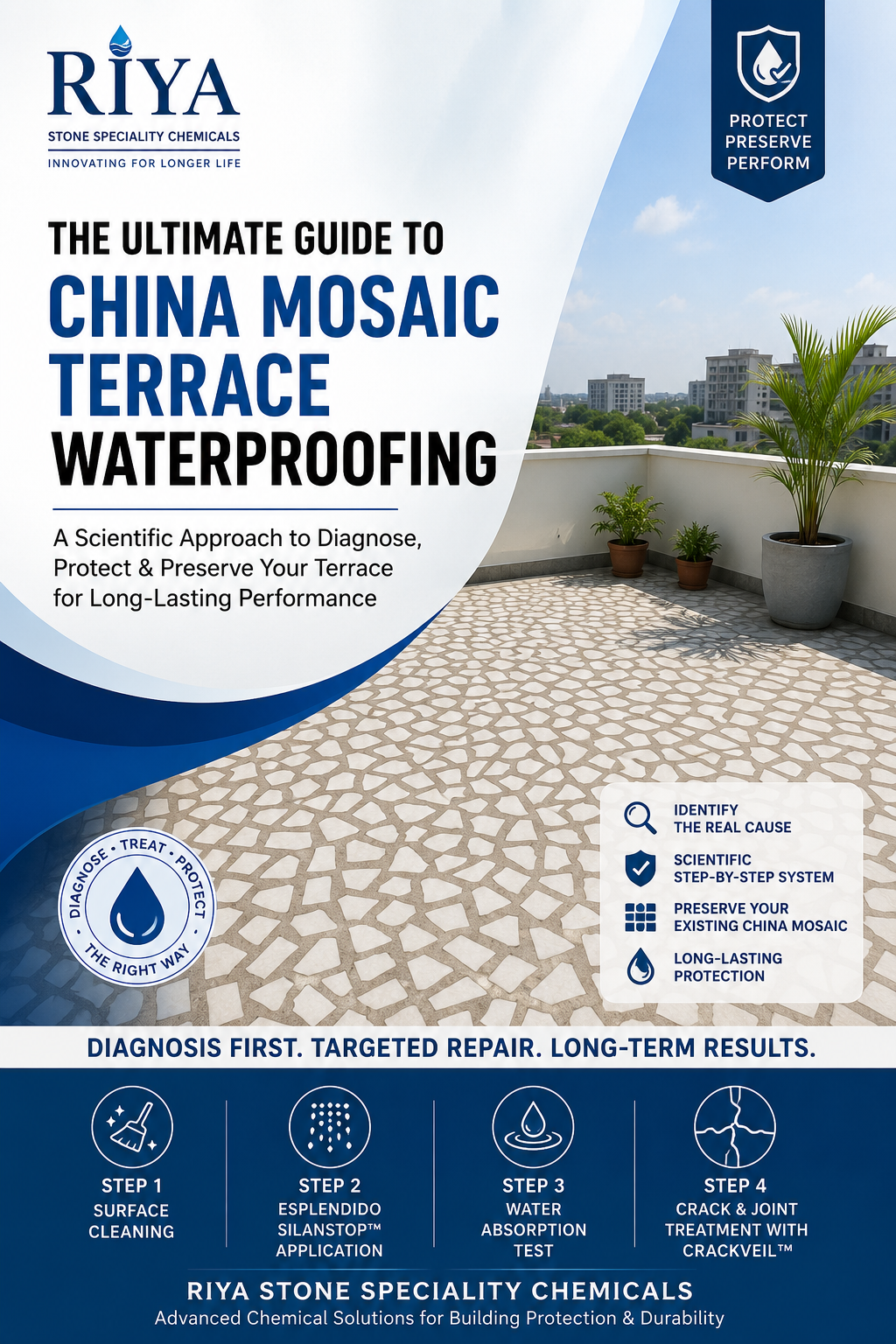
The complete treatment process consists of four essential steps.
Before any waterproofing treatment begins, the entire terrace should be thoroughly cleaned.
Dust, dirt, algae, loose particles, previous repair residues and other contaminants should be removed to expose the actual condition of the China Mosaic surface.
A clean surface allows weak grout joints, damaged areas and hairline cracks to be identified more accurately.
Surface cleaning also helps ensure uniform application of subsequent treatments.
After cleaning, ESPLENDIDO SILANSTOP™ is uniformly applied over the entire China Mosaic terrace.
Unlike conventional waterproof coatings that remain on the surface, ESPLENDIDO SILANSTOP™ is designed to penetrate into the porous cement grout joints and mortar surrounding the mosaic pieces.
The objective of this treatment is to help manage moisture movement and salt migration within the terrace system while preserving the original appearance of the China Mosaic surface.
The treatment is applied using a brush, roller or low-pressure spray after proper dilution according to the recommended application method.
Once applied, the terrace is allowed to stabilize before proceeding to the next stage.
This is one of the most important and often overlooked stages of the entire waterproofing process.
Instead of assuming that every part of the terrace requires repair, the surface is first checked to identify whether any areas continue absorbing water.
Water is spread across the terrace and the surface is carefully observed.
Areas where water continues to be absorbed may indicate:
This step helps identify the actual problem locations instead of carrying out unnecessary repairs over the entire terrace.
After the Water Absorption Test, any identified weak joints, cracks or defective areas should be repaired using an appropriate crack-bridging repair material such as ESPLENDIDO CRACKVEIL™.
Instead of coating the entire terrace unnecessarily, repairs are carried out only where the inspection indicates moisture pathways.
This targeted repair approach helps preserve the original China Mosaic surface while addressing the actual points through which moisture enters.
Each step performs a specific function.
Surface Cleaning prepares the terrace.
ESPLENDIDO SILANSTOP™ helps manage moisture movement within the substrate.
The Water Absorption Test identifies hidden weak areas.
CRACKVEIL™ repairs only the locations that actually require treatment.
Together, these four stages create a scientific and systematic approach to China Mosaic terrace waterproofing rather than relying on trial-and-error waterproofing methods.
Every successful waterproofing project begins with proper surface preparation.
No waterproofing technology can perform to its full potential if it is applied over a dirty, contaminated or poorly prepared surface.
For this reason, surface cleaning is one of the most important stages of the complete China Mosaic waterproofing process.
Over the years, a China Mosaic terrace accumulates:
These contaminants may hide weak joints, cracks and damaged areas that require attention.
Cleaning the terrace makes the actual condition of the surface clearly visible before any treatment begins.
Many waterproofing problems remain unnoticed simply because they are hidden beneath dirt or biological growth.
Once the terrace has been thoroughly cleaned, it becomes much easier to identify:
Accurate inspection at this stage helps prevent unnecessary waterproofing work later.
Surface cleaning also ensures that ESPLENDIDO SILANSTOP™ can be applied uniformly across the entire terrace.
A properly cleaned surface allows the treatment to interact more consistently with the exposed grout joints and cementitious areas that require moisture management.
This creates better conditions for the next stages of the waterproofing process.
It is important to understand that cleaning alone does not waterproof the terrace.
Its purpose is to prepare the surface, expose hidden defects and create the ideal conditions for subsequent treatment.
Skipping this step may reduce the effectiveness of the entire waterproofing system because hidden defects can remain undetected.
Although surface cleaning appears to be a simple operation, it forms the foundation of the complete treatment process.
A well-prepared terrace allows every subsequent step—from ESPLENDIDO SILANSTOP™ application to the Water Absorption Test and CrackVeil™ repair—to be carried out more accurately and effectively.
For this reason, every successful China Mosaic waterproofing project should begin with a clean, properly inspected terrace surface.
After the terrace has been thoroughly cleaned and inspected, the next step is the application of ESPLENDIDO SILANSTOP™.
This is one of the most important stages of the entire waterproofing process because it is performed before identifying weak joints and cracks.
Many conventional waterproofing systems begin by filling visible cracks first.
Our approach is different.
We first treat the entire China Mosaic terrace with ESPLENDIDO SILANSTOP™, allowing the technology to interact with the complete terrace system before carrying out the Water Absorption Test.
This enables us to identify the actual weak areas that still require repair instead of repairing the entire terrace unnecessarily.
Every China Mosaic terrace contains thousands of grout joints and microscopic pores.
Some of these areas remain perfectly healthy, while others may have become weak over time.
Without proper evaluation, it is impossible to know which locations actually require repair.
Applying ESPLENDIDO SILANSTOP™ first prepares the terrace for the next stage—the Water Absorption Test—which helps identify only those areas that continue allowing moisture to enter.
ESPLENDIDO SILANSTOP™ should be applied uniformly over the complete China Mosaic surface using:
The product should be diluted according to the recommended application instructions before use.
Uniform application ensures that the entire terrace receives consistent treatment before inspection continues.
One of the major advantages of this system is that the original appearance of the China Mosaic terrace is preserved.
There is no need to apply thick surface coatings or alter the architectural finish simply to begin the waterproofing process.
The terrace continues to retain its original appearance while becoming ready for the next stage of inspection.
The objective of this step is not to complete the waterproofing process.
Its purpose is to prepare the terrace for the most important stage of the system—the Water Absorption Test.
Only after this test can the actual weak joints, porous areas and hidden moisture pathways be accurately identified.
This scientific sequence helps eliminate unnecessary repairs and allows waterproofing efforts to focus only on the areas that truly require attention.
The Water Absorption Test is one of the most important stages of the entire China Mosaic waterproofing system.
Unfortunately, it is also one of the most frequently skipped steps in conventional waterproofing projects.
Many contractors begin repairing cracks immediately after applying waterproofing products.
However, without verifying how the terrace behaves when exposed to water, hidden weak areas often remain undetected.
The Water Absorption Test removes this uncertainty.
After the ESPLENDIDO SILANSTOP™ treatment has stabilized, clean water is spread uniformly across the terrace surface.
The objective is simple:
Observe how every part of the terrace responds to water.
A properly performing surface should resist water absorption uniformly.
Any location that continues absorbing water behaves differently from the surrounding terrace and requires further investigation.
The Water Absorption Test helps identify areas that may contain:
Instead of guessing where the problem might exist, the terrace itself indicates the areas requiring attention.
Traditional waterproofing often treats the entire terrace in exactly the same way.
The Water Absorption Test allows repairs to become far more precise.
Only the identified weak locations require crack treatment, reducing unnecessary repair work while preserving healthy sections of the terrace.
This targeted approach improves both efficiency and long-term waterproofing performance.
Skipping the Water Absorption Test means relying entirely on visual inspection.
Unfortunately, many moisture pathways remain invisible until leakage appears inside the building.
By verifying the behaviour of the terrace under actual water exposure, hidden weak areas can be identified before they develop into future leakage problems.
This makes the Water Absorption Test one of the most valuable quality-control stages in the complete waterproofing system.
Once the Water Absorption Test has been completed, every weak area requiring repair has been identified.
The next step is straightforward.
Instead of coating the entire terrace unnecessarily, repairs are carried out only where the terrace actually needs them.
This creates a faster, more scientific and more economical waterproofing process while preserving the original China Mosaic surface.
After completing the Water Absorption Test, the terrace itself reveals which areas require attention.
Instead of assuming that the entire terrace needs repair, only the identified weak locations are treated.
This is where ESPLENDIDO CRACKVEIL™ becomes an important part of the waterproofing system.
Many waterproofing contractors begin by filling every visible crack before understanding how the terrace actually behaves.
Our approach is different.
The Water Absorption Test is performed first to identify the locations where moisture is still entering the terrace.
Only after these weak areas have been identified are repairs carried out.
This prevents unnecessary repairs and ensures that attention is focused on the actual moisture pathways.
CRACKVEIL™ should only be applied where defects have been identified, including:
There is no need to apply crack repair material over healthy areas that are already performing properly.
One of the biggest advantages of this system is precision.
Instead of coating or repairing the entire terrace, only the defective locations are repaired.
This provides several benefits:
Once all identified weak joints and cracks have been repaired, the terrace becomes significantly more resistant to future moisture ingress.
By combining:
the waterproofing process becomes based on diagnosis rather than assumption.
Instead of repairing everything, only the areas that genuinely require treatment are repaired.
This scientific approach improves quality while preserving the original terrace finish.
For many years, terrace waterproofing has followed a simple approach.
A leakage appears.
A coating is applied.
If leakage returns, another coating is applied.
Eventually, the entire terrace is broken and rebuilt.
Unfortunately, this cycle often repeats because the actual cause of leakage is never fully understood.
The China Mosaic Waterproofing System described in this guide follows a completely different philosophy.
Instead of beginning with products, it begins with diagnosis.
In many traditional waterproofing projects, the sequence is often:
Leakage Appears
↓
Apply Waterproof Coating
↓
Hope the Leakage Stops
↓
Leakage Returns
↓
Apply Another Waterproof Coating
↓
Repeat the Same Process
While this approach may solve certain problems, it does not always identify where water is entering or how moisture is travelling beneath the terrace.
The system explained in this guide follows a structured sequence:
Inspect the Terrace
↓
Clean the Surface
↓
Apply ESPLENDIDO SILANSTOP™
↓
Perform Water Absorption Test
↓
Identify Weak Areas
↓
Repair Only the Defective Joints & Cracks
↓
Complete the Waterproofing System
Each step provides information for the next.
Instead of making assumptions, every stage helps verify the actual condition of the terrace before proceeding further.
One of the biggest advantages of this approach is that it focuses on preserving the existing China Mosaic terrace whenever possible.
Rather than recommending immediate demolition, the system first evaluates whether the terrace can be restored through scientific inspection and targeted treatment.
This helps reduce unnecessary demolition, construction waste and project costs while maintaining the original architectural finish.
The philosophy behind this waterproofing system is simple:
Do not repair what is not damaged.
Every terrace contains healthy areas as well as weak areas.
The objective is to accurately identify the locations where moisture enters and repair only those locations that require attention.
This makes the waterproofing process more logical, efficient and technically sound.
Successful waterproofing is not determined by how many products are applied.
It depends on understanding:
When waterproofing follows this scientific sequence, the process becomes more accurate, more economical and better suited for achieving long-term performance.
Below are answers to some of the most frequently asked questions about China Mosaic terrace waterproofing, leakage, ESPLENDIDO SILANSTOP™ and the step-by-step waterproofing system explained in this guide.
Yes, in many cases it is possible.
If the existing China Mosaic surface is structurally sound, a scientific inspection can help identify the actual weak joints, cracks or moisture pathways. Depending on the terrace condition, targeted treatment may be sufficient without removing the existing China Mosaic.
No.
Many terraces continue performing well even after several years. Leakage often begins only through localized weak joints, hairline cracks or damaged repair areas.
A proper inspection should always be carried out before deciding to remove the entire terrace.
During rainfall, water remains on the terrace for longer periods and gradually finds weak joints or porous areas through which it can enter.
Once the rain stops, these areas may dry, making the leakage appear seasonal.
Moisture can travel beneath the China Mosaic through porous construction materials.
As a result, water may enter at one location but appear inside the building at a completely different location.
ESPLENDIDO SILANSTOP™ is applied before the Water Absorption Test to prepare the terrace and help manage moisture movement within the substrate.
It also allows the Water Absorption Test to more accurately identify weak areas that still require repair.
The Water Absorption Test identifies the exact locations that continue absorbing water after treatment.
These areas usually indicate weak joints, porous mortar or hidden cracks that require further attention.
Without this test, many waterproofing projects rely only on visual inspection.
The test first identifies the actual weak areas.
Repairing cracks after this inspection ensures that repairs are carried out only where necessary instead of treating the entire terrace unnecessarily.
Yes.
One of the objectives of this approach is to preserve the existing China Mosaic surface whenever possible while addressing the actual causes of leakage.
Yes.
Older China Mosaic terraces can often be evaluated using the same systematic approach, provided the existing surface remains structurally stable.
If you notice recurring leakage, damp ceilings, white salt deposits, peeling paint or repeated waterproofing failures, a professional inspection is recommended before selecting any waterproofing treatment.
China Mosaic terraces have protected Indian homes for decades because of their durability, weather resistance and excellent thermal performance.
However, like every construction system, they require the correct maintenance and a scientific approach when waterproofing problems develop.
One of the biggest mistakes is assuming that every leaking terrace must be demolished and rebuilt.
In many situations, the actual problem lies in weak grout joints, localized cracks or moisture pathways rather than the China Mosaic surface itself.
Understanding where water enters, how moisture travels and which areas actually require repair is the foundation of successful waterproofing.
The step-by-step system explained in this guide follows a logical sequence:
Instead of relying on assumptions, each stage provides valuable information that helps identify the real cause of leakage before repairs are carried out.
This scientific approach not only improves the efficiency of the waterproofing process but also helps preserve the original China Mosaic terrace while avoiding unnecessary demolition and repair costs.
At Riya Stone Speciality Chemicals, we believe that successful waterproofing begins with understanding the problem—not simply covering it.
By combining proper diagnosis, moisture management, systematic inspection and targeted repairs, long-term waterproofing becomes a more practical, reliable and technically sound process.
If your China Mosaic terrace is showing signs of leakage, damp ceilings or recurring waterproofing failures, our technical team can help you understand the problem and recommend the most suitable treatment approach based on your terrace condition.
Explore our waterproofing technologies, application guides and educational resources to learn more about scientific China Mosaic terrace waterproofing solutions designed for long-term building protection.
Choosing the right waterproofing products is just as important as following the correct application sequence.
Every product used in the system performs a specific function. Together, they form a complete waterproofing process designed to identify, treat and repair moisture-prone areas while preserving the original China Mosaic surface.
ESPLENDIDO SILANSTOP™ is the foundation of the entire waterproofing system.
Applied immediately after surface cleaning, it prepares the terrace before the Water Absorption Test and helps manage moisture movement and salt migration within the terrace system.
After completing the Water Absorption Test, all identified weak joints, cracks and defective areas should be repaired using ESPLENDIDO CRACKVEIL™.
Instead of repairing the entire terrace unnecessarily, CRACKVEIL™ is applied only where the inspection confirms the presence of weak areas.
Each product performs a different role.
ESPLENDIDO SILANSTOP™
↓
Helps prepare the terrace and manage moisture movement.
↓
Water Absorption Test
↓
Identifies the actual weak areas.
↓
ESPLENDIDO CRACKVEIL™
↓
Repairs only the identified weak joints and cracks.
Instead of applying unnecessary materials across the entire terrace, this system focuses on diagnosis, targeted repairs and long-term performance.
For optimum results, every China Mosaic terrace should be:
Following this sequence provides a logical and systematic approach to China Mosaic terrace waterproofing.
China Mosaic terraces have protected millions of Indian homes for generations.
Their durability and long service life make them one of the most reliable roofing systems ever used in residential construction.
However, when leakage develops, the solution should not be based on assumptions.
Breaking the entire terrace or repeatedly applying new waterproof coatings may not always solve the actual problem.
The most effective waterproofing begins by understanding where water enters, how moisture travels and which areas genuinely require repair.
That is the philosophy behind the step-by-step system explained in this guide.
By combining:
the waterproofing process becomes based on diagnosis rather than guesswork.
Instead of repairing everything, the focus shifts to repairing only what actually needs attention.
This not only helps preserve the original China Mosaic surface but can also reduce unnecessary demolition, save time and improve the efficiency of the waterproofing process.
At Riya Stone Speciality Chemicals, we believe that successful waterproofing starts long before a waterproof coating is applied.
It starts with understanding the science behind moisture movement, identifying the root cause of leakage and following a systematic treatment process designed for long-term performance.
When the right technology is combined with the right application sequence, waterproofing becomes more than just a repair—it becomes a smarter way to protect your building for years to come.
If your China Mosaic terrace is showing signs of leakage, damp ceilings or recurring waterproofing failures, our technical team can help you identify the root cause and recommend the most appropriate treatment system for your project.
Riya Stone Speciality Chemicals
Technical Support: +91 84418 04441
Email: riyastonespecialitychemicals@
Website: www.
Protect your terrace with the right diagnosis, the right technology and the right waterproofing system.